The book · out now on Amazon
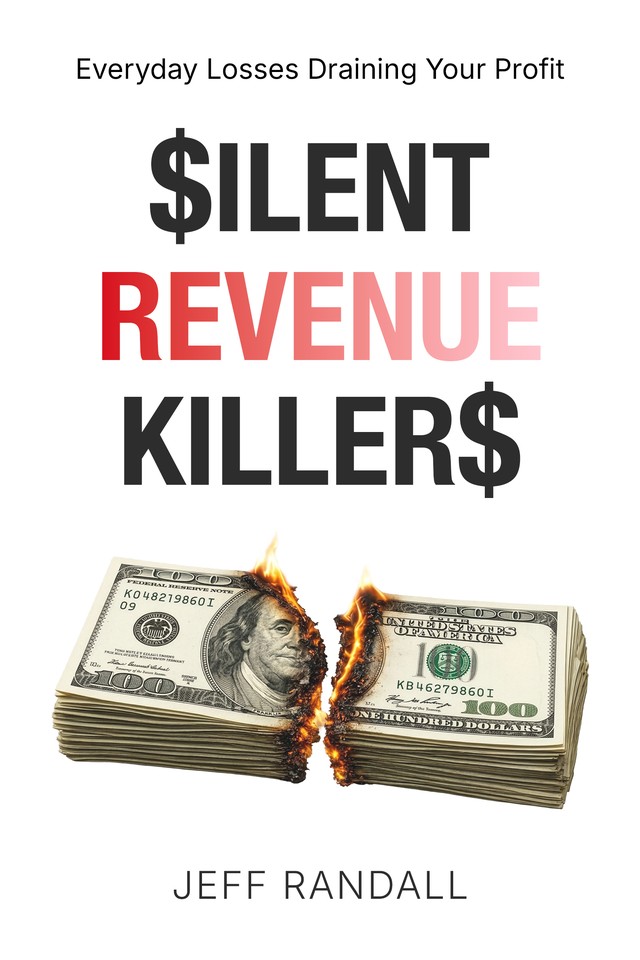
The Everyday Losses Draining Your Profit
Thirteen ordinary patterns quietly draining revenue from companies that look perfectly healthy.
Each one named, each one costed, each one with a fix that doesn’t require buying anything.
"A lot of business books focus on growth strategies and scaling techniques. This book approaches organizations from a different direction. There will probably be moments where parts of it feel familiar in an uncomfortable way. I think that is part of what makes it useful."
Allen Padilla · CEO, The CSU Foundation · from the forewordThe question behind the book
An executive once told me that losing half the pipeline was normal. Industry standard, he said.
I have never stopped questioning that. Who decided on fifty? What would be different at forty? Every company has a number like it somewhere — inherited, repeated, and eventually defended as just how things are.
Once a loss is normal, it stops being anyone’s job to go looking for it. This book is about the losses that got called acceptable, what they actually cost, and why a company working hard to grow keeps paying for them.
50%the pipeline loss he called an industry standard
If you could do better than half, what would that be worth?
The assumption
That is how almost every growth plan begins. If the number has to go up, something has to go up with it — the lead count, the headcount, the tool stack, the budget, the hours.
Sometimes adding works. Often it just costs more to stand still, and next year the same conversation happens again with a bigger number attached.
This book asks the other question. Not what to add. What is already leaving, and where it goes.
What you get
Thirteen losses, one per chapter, each worked the same way. Whichever one you open, you get the same three things.
You do not have to finish it to use it. Any chapter works on its own.
What’s inside
Not a comprehensive list — every company has its own version of waste and friction. These are the patterns that show up most often, in most places.
Before you decide
The closing pages of chapter thirteen, in full and unedited — the story, the turn, and the line it lands on. If you don’t like the way it reads, you have saved yourself the money.
The book
Paperback and Kindle on Amazon.
Bulk copies for a leadership team, or a copy for a review — email me at hello@jeffrandall.co.
Free companion · after you read it
Every calculation in the book is worked on Veridian, a fictional $50M company carried from the first chapter to the last so you can watch one business leak in thirteen places. The workbook is those same tables, with an empty column for your numbers.
Ch 1 · Manual work one of fifteen tabs
| Veridian | Yours | |
|---|---|---|
| Reps | 20 | |
| Hours per rep per week on CRM admin | 8 | |
| Loaded hourly rate, rep | $100 | |
| Annual rep labor cost | $832,000 |
Where to find it: ask three reps how long they spend each week on CRM admin, and average it.
Fifteen tabs, all built like that one.
One field. The file is on the next page.
I keep the address, and I may write to you about the consulting practice. That is the whole trade. No drip campaign, no follow-up series, nothing else happens.
The talent isn’t missing. The process isn’t unfixable. The revenue isn’t gone. It is sitting in the gap between what your company says it values and what it does.