The book · coming to Amazon

Silent Revenue Killers

The Everyday Losses Draining Your Profit

Thirteen ordinary patterns quietly draining revenue from companies that look perfectly healthy.

Each one named, each one costed with the arithmetic worked all the way through on a single example company, each one with a fix that doesn’t require buying anything.
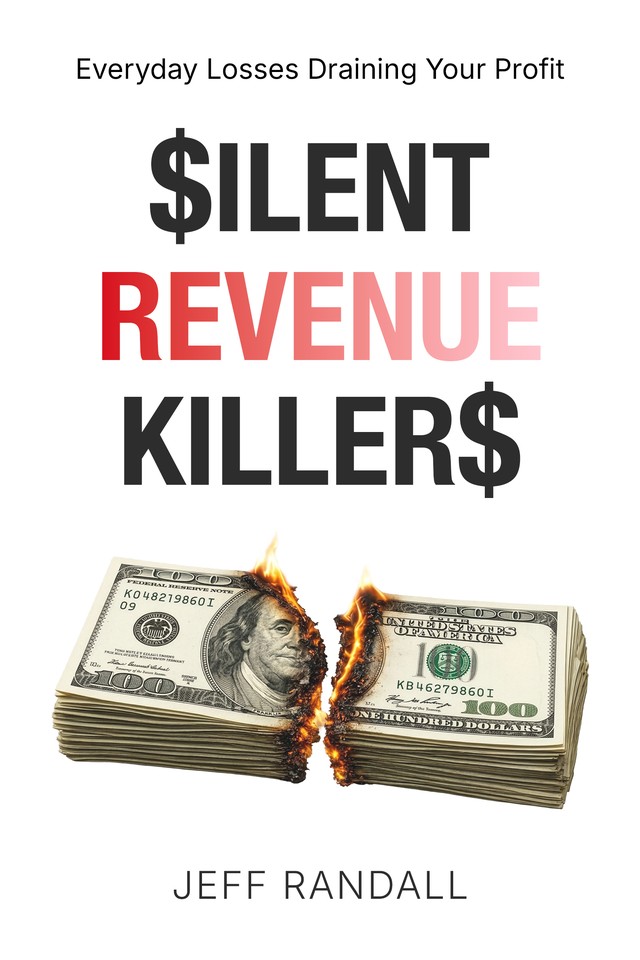
Silent Revenue Killers by Jeff Randall — book cover

"A lot of business books focus on growth strategies and scaling techniques. This book approaches organizations from a different direction. There will probably be moments where parts of it feel familiar in an uncomfortable way. I think that is part of what makes it useful."

Allen Padilla · CEO, The CSU Foundation · from the foreword

The question behind the book

How much loss is acceptable?

I asked an executive once what acceptable loss looked like for a sales pipeline.

He said 50%.

I asked where he got that number. He said it was industry standard.

Every company has decided, somewhere along the line, how much loss it is willing to live with. Almost nobody remembers deciding. The figure gets inherited, repeated, and eventually defended as normal — and once a loss is normal, it stops being anyone’s job to go looking for it.

This book is about the losses that quietly got classified as acceptable: what they actually cost, and why a company working hard to grow will keep paying for them.

50%the pipeline loss he called an industry standard

I never accepted that answer. Not then. Not now.

The assumption

To grow, you have to do more of something.

That is how almost every growth plan begins. If the number has to go up, something has to go up with it — the lead count, the headcount, the tool stack, the budget, the hours.

Sometimes adding works. Often it just costs more to stand still, and next year the same conversation happens again with a bigger number attached.

This book asks the other question. Not what to add. What is already leaving, and where it goes.

More leads More reps More tools More marketing More training More hours MORE of something

What you get

You finish a chapter holding a number and something to do about it.

Not a framework and not a case study. Each chapter names one loss, works the arithmetic all the way through on a single company, then hands you the same calculation to run on your own records.

A figure you can defendYou stop guessing what a problem costs Every chapter ends in a number you can produce from records you already have, and take into a room where somebody will check it.
A fix, not a theoryYou know what to change on Monday Each one comes with a specific fix drawn from experience. Several need no budget, no new software and nobody’s permission.
Something that keeps workingYou can run it again next year The last chapter turns the book back on you — a short self-assessment, and one thing to change in the next thirty days.

You do not have to finish it to use it. Any chapter works on its own.

What’s inside

The thirteen patterns.

Not a comprehensive list — every company has its own version of waste and friction. These are the patterns that show up most often, in most places.

01
Fictional PipelinesDecisions made on numbers nobody fully trusts.
02
Reactive FirestormsTime spent on recurring problems instead of the system creating them.
03
Busy Is Not the Same as WorkingInvisible underperformance, and the weight it puts on everyone else.
04
Stolen Productive TimeMeetings, interruptions and admin consuming the hours you pay for.
05
Overlooked TalentGood people screened out before anyone ever meets them.
06
The Path of Least ResistanceBadly built systems quietly teaching people the wrong behavior.
07
Unequal TerritoriesSame quota, completely different work behind it.
08
Customer NeglectRelationships that erode long before anyone churns.
09
Ideas That Never Make ItSignals arriving and dying before they reach a decision.
10
Legacy Processes Nobody QuestionsComplexity mistaken for necessity.
11
The Money Nobody Is WatchingSpend nobody checks, and revenue earned but never collected.
12
Too Busy to ImproveNo capacity left to fix what keeps causing the problems.
13
Unmanaged DiscountingThe price you charge drifting away from the price you think you charge.

Before you decide

Read the end of chapter thirteen.

The closing pages of chapter thirteen, in full and unedited — the story, the turn, and the line it lands on. If it is not how you want to be written to, you have saved yourself the money.

Free companion · no charge

The book’s own tables, as a spreadsheet you can fill in.

Every calculation in the book is worked through on one example company. This file is those same tables — the example sitting in a grey reference column, and an empty column beside it for your numbers. Fifteen calculations across twelve chapters.

Ch 1 · Manual work one of fifteen tabs

 VeridianYours
Reps20
Hours per rep per week on CRM admin8
Loaded hourly rate, rep$100
Annual rep labor cost$832,000

Where to find it: ask three reps how long they spend each week on CRM admin, and average it.

Every tab looks like that. The book’s example company on the left so you can see a finished one, an empty column for yours, and a note saying where the number usually lives.

Fifteen tabs across twelve chapters, plus a summary that refuses to inflate — it leaves out figures that would double-count — and a last tab listing the five losses a spreadsheet genuinely cannot reach.

Send me the workbook

One field. The file is on the next page.

I keep the address, and I may write to you about the consulting practice. That is the whole trade — there is no sequence behind this and nothing else happens.

Get a copy

The book is coming. The workbook is here.

Paperback and Kindle shortly. The companion workbook is finished and free today. Leave an email and I’ll tell you the day the book lists.

The talent isn’t missing. The process isn’t unfixable. The revenue isn’t gone. It is sitting in the gap between what your company says it values and what it does.

Bulk copies for a leadership team, or a copy for a review — email me at hello@jeffrandall.co.